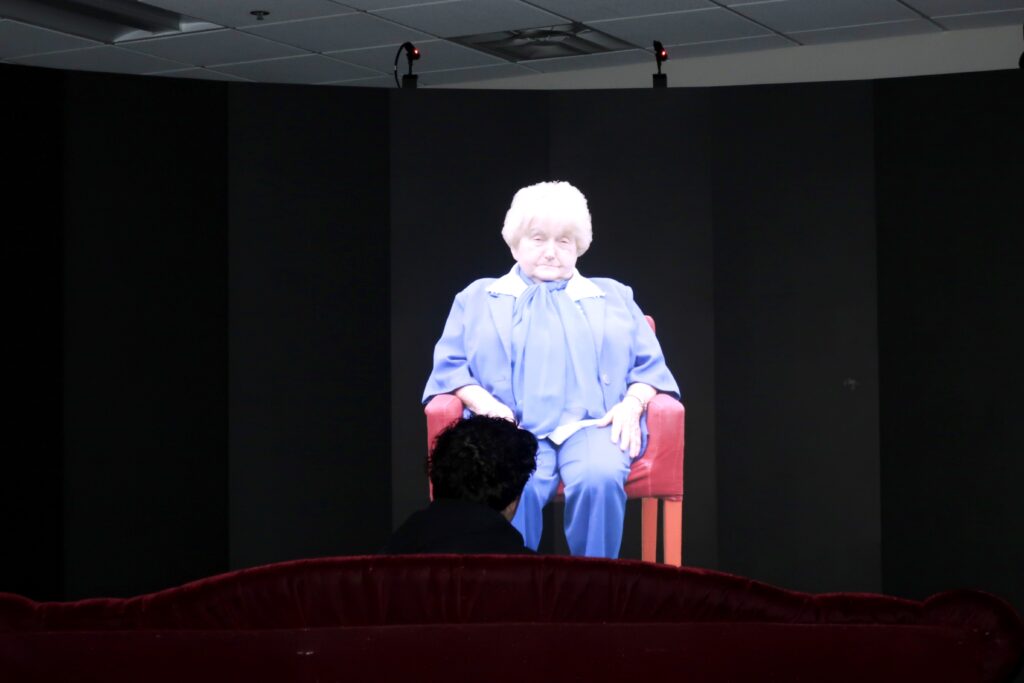
Seven Holocaust survivors shared their stories with St. Thomas students and faculty in a new way this spring, thanks to artificial intelligence.
Throughout March and April, the IWitness Interactive Experience in O’Shaughnessy Science Hall’s lower level allowed users to ask survivors questions and receive responses in real time. I sat down and talked with several survivors via technology from the University of Southern California Shoah Foundation, which combs through over 55,000 hours of interviews, searching for the best answers to your question.
Kim Vrudny, an associate dean for the College of Arts and Sciences, helped bring the installation to St. Thomas. She said she felt that speaking with survivors through the screen helped break emotional barriers.
“In a way, I think I would have been shy to ask some of these questions in front of a live human being, but there was something about the technology and the way that I could interface with the survivor that I was freer,” Vrudny said.
Sophomore Elise Fouts, who worked as a visitor experience specialist at the installation, was immediately interested when she saw the interactive experience with the Holocaust survivors while looking for a campus job.
“I would go see this, whether I was working or not,” Fouts said. “This is great, to have more time to be exposed to something like this.”
Many people incorrectly thought the answers were AI-generated, according to Fouts.
“It is not generating memories,” Vrudny said. “It’s really a search mechanism; it’s functioning in the same way as a Google search engine.”
The experience itself is surreal. As survivors respond, participants can see them anxiously bouncing their legs when speaking about difficult memories. When waiting for a question, the survivors idle, blinking or slightly nodding, almost as if they are encouraging you to ask the uncomfortable questions.
When you take a seat on the red couches and look into the eyes of a survivor, it can be hard to know what to ask. Pressing the microphone on the iPad in front of you, a world of opportunities opens without the fear of being taboo breathing down your neck.
I spoke to a projection of Eva Kor, who was experimented on alongside her twin, Miram, at Auschwitz-Birkenau. Pinchas Gutter described fleeing the Nazis and, after being captured, surviving six concentration camps. Ben Ferencz spoke of his experience as chief prosecutor at the Einsatzgruppen trial in Nuremberg, Germany, where 24 former Schutzstaffel –a Nazi unit that carried out mass extermination, among other atrocities– leaders were found guilty.
Much like Vrudny, who “had chills for an extended period of time,” after talking to the survivors, I also did not know how to process some of the memories I heard. Using technology like this preserves the memory of survivors like Ferencz, who died in 2023, allowing them to share their stories indefinitely.
Anyone who missed the opportunity to interact with these survivors during the exhibition can still speak to them via the IWitness website.
Grace Woelfel can be reached at woel8456@stthomas.edu.